Bedding Marketing · Trust & Transparency
How Bedding Brands Can Make Protector Performance Claims More Credible
A mattress protector is asked to do two seemingly opposing things: shield a sleep surface and leave its comfort undisturbed. For brands, describing that balance takes more than a string of reassuring adjectives. Specific, substantiated language can help shoppers understand what a protector does, where its limits lie, and whether it suits their mattress and routine.
Published November 3, 2026
On a product page, “waterproof,” “breathable,” and “comfortable” can look like a complete story. They are not. Each word raises a practical question. What kind of liquid protection is intended? What does breathable mean in the context of this particular construction? How deep a mattress can the fitted skirt accommodate? Will the protector make a crinkling sound, alter the surface feel, or need special care?
Shoppers are not asking for a dissertation in textile engineering. They are asking for details that let them picture the product in everyday use. A credible bedding claim gives them those details in plain language, distinguishes tested performance from broad description, and does not imply more than the evidence can support. That approach is not simply a matter of regulatory caution. It is a more considered form of product storytelling: one that treats the customer as a discerning participant rather than an audience for superlatives.
For mattress and bedding marketers, the opportunity is to make product messaging both elegant and exact. The aim is not to strip away emotion, but to give it a trustworthy foundation.
Start by translating the headline
Performance language works best when a feature is immediately translated into a customer-relevant explanation. “Fits mattresses up to 18 inches deep” is more useful than “deep-pocket design” alone. “Machine washable” provides a clearer care expectation than “easy to maintain.” A description such as “designed to protect against everyday spills” communicates a more bounded promise than a universal-sounding claim of total protection.
This translation requires a simple editorial discipline: whenever a feature appears in a headline, ask what a shopper would need to know before relying on it. The answer may be a measurement, a material, a use condition, a care instruction, or a limitation. If the brand cannot answer the question, the claim may need to be narrowed or removed.
- Waterproof: Explain the type of protection being claimed and, where relevant, what testing or construction supports it.
- Breathable: Say whether the claim refers to material design, airflow, or a measured result. Avoid presenting the word as a guarantee that every sleeper will feel cool.
- Quiet or crinkle-free: Describe the materials or construction associated with the sound claim, and avoid implying that every bed, room, or sleeping style will produce the same experience.
- Secure fit: Provide the maximum compatible mattress depth and any conditions that affect fit, such as a thick topper or unusually deep pillow-top.
- Comfort-preserving: Explain what is intended to remain unchanged, such as the mattress’s surface feel, rather than making an absolute promise about every user’s perception.
Specificity does not make copy less inviting. It gives the invitation shape. “A flexible fitted design accommodates mattresses up to 18 inches deep” offers a more useful picture than “fits beautifully.” The latter may sound polished; the former helps someone check a measurement before ordering.
Treat waterproofing as a defined promise
Waterproofing is among the most consequential mattress protector claims because it can influence a purchase made to guard against accidents, spills, or other moisture. A consumer who reads “waterproof” may reasonably expect liquid to be kept from reaching the mattress. The brand should therefore be prepared to describe what that statement means for the product, not rely on the word as a self-explanatory badge.
Useful supporting details may include the construction responsible for the barrier, the types of liquids considered in a test, the method and conditions used, and the care or usage instructions that preserve performance. If a claim is based on a particular laboratory test, the page should make the test understandable: what was evaluated, under what conditions, and what the result does—and does not—establish. A test result should not be made to sound broader than its scope.
Brands should also distinguish between a feature and a guarantee of every real-world outcome. A protector may be designed to resist liquid penetration, yet performance can depend on correct placement, product condition, laundering, the volume of a spill, or how long liquid remains on the surface. Those qualifications should be stated in a proportionate, accessible way. A caveat buried in dense legal copy cannot reliably correct an expansive headline.
Where the product information describes a waterproof design and a maximum fit depth, those details can be presented together. For example, a brand might explain that a particular protector is designed to guard against spills and fits mattresses up to a stated depth. That is more informative than leading with “complete protection” while leaving shoppers to infer fit and use conditions.
Make “breathable” more than a mood
Breathability is attractive language in bedding, but it can mean different things to different readers. Some may interpret it as airflow through a fabric; others may understand it as a promise of cooler sleep. Those are not automatically equivalent. A textile’s structure, the presence of a protective layer, the mattress beneath it, bedding layers above it, bedroom conditions, and personal comfort can all shape the experience.
Marketers should therefore be precise about the level of the claim. If the product is designed to allow airflow, describe that design intention and identify the relevant construction where possible. If the brand has measured air permeability or another performance characteristic, explain the method and result in language a non-specialist can follow. If there is no test supporting a quantified claim, avoid suggesting that a measurable result has been established.
It is equally important to avoid turning a material characteristic into a universal sleep outcome. “Designed to support airflow” is a claim about the product’s intended function. “Keeps every sleeper cool all night” is a much broader promise that depends on factors beyond the protector alone. Credibility comes from respecting that distinction.
Product pages can also help readers separate related ideas. Breathability, moisture management, and cooling are often grouped together, but they are not interchangeable. If a protector is described as breathable, the copy should not silently expand that into claims about sweat reduction or temperature regulation unless the brand can substantiate those specific benefits.
Fit is performance, not fine print
A protector that cannot stay in place is unlikely to deliver the experience a shopper expects, however impressive its materials may be. Fit is therefore central to product performance and should be treated as a first-order buying detail—not a specification tucked at the bottom of the page.
Publish the maximum mattress depth clearly, and explain what the measurement includes. Does the stated limit account for a topper? Is it the height of the mattress alone, or the combined height of the mattress and added layers? Are the pockets elasticated or stretch knit? If the product is oversized before washing or may shrink according to its care instructions, explain that before purchase. A customer should be able to compare the product specification with the actual bed at home.
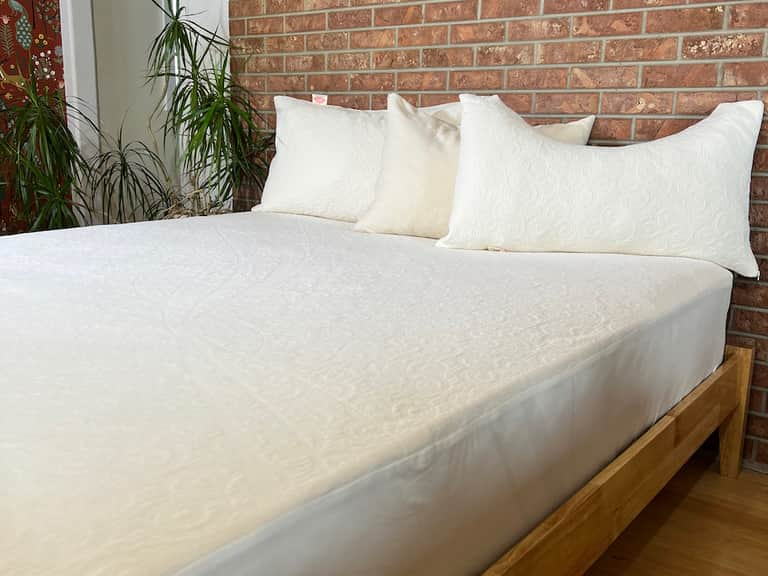
Real product information offers useful examples of the level of detail a shopper can use. The Suite Sleep Organic Cotton Knit Mattress Protector is described as having a fitted design with 18-inch pockets and a stretch-knit construction. Its product details also state that it is made from 100% GOTS-certified organic cotton and is machine washable, with care instructions specifying cold or warm washing and low-to-medium machine drying. These particulars help define the product more concretely than a general promise of a “perfect fit.”
Fit language should remain consistent across the product page, size selector, packaging, retailer listings, and paid campaigns. If one channel says 18 inches and another says 16, the discrepancy undermines confidence before the customer has even opened the package. A shared source of approved specifications can prevent such contradictions.
Separate comfort language from evidence
Comfort is personal, which makes it both essential to bedding copy and easy to overstate. A protector can be designed to add little bulk, use a soft surface fabric, or preserve the feel of a compatible mattress. Those are descriptions of construction or intended interaction. They are not proof that every customer will find the product comfortable.
When a brand says a protector “preserves the feel” of a mattress, it should clarify the basis for that statement. Is the product designed with a thin profile? Does it use a stretch material? Is the claim tied to a particular mattress model? A statement that the protector is intended to maintain a mattress’s existing feel is more transparent than an absolute promise that the product will be imperceptible to all sleepers.
Likewise, “quiet” deserves context. If the materials are designed to reduce rustling, say so, but avoid presenting the result as a universal guarantee unless the claim has been tested under appropriate conditions. Copy can acknowledge an intended benefit while avoiding the suggestion that sound depends on the protector alone.
The Breathable Mattress Protector 2023 is described as protecting against normal wear and tear without blocking airflow, while preserving the feel of a compatible Casper mattress. That kind of compatibility language is helpful because it gives the shopper a context for the claim. A brand should still make the basis and limits of “preserves the feel” clear wherever the phrase is used, rather than allowing it to become a free-floating guarantee.
Put materials and care in the main story
Materials are not decorative detail. They shape the product’s construction, touch, care requirements, and sometimes the basis for its performance story. A clear materials section should identify what the protector is made from, where relevant distinguish the surface fabric from any backing or barrier layer, and avoid broad environmental or health claims that the evidence does not establish.
Care instructions deserve similar prominence. Washing temperature, detergent recommendations, whether bleach or fabric softener should be avoided, and drying guidance can matter to both convenience and product longevity. If care affects performance, explain that relationship plainly. “Machine washable” is a useful start; it does not answer every question about how to wash the item or whether particular methods are discouraged.
Brands should also be cautious with terms such as “organic,” “natural,” “hypoallergenic,” or “chemical-free.” Each can carry significant implications for shoppers. Use certification language accurately, identify the material or component the certification covers, and do not imply that a certified fiber automatically makes every part of a finished protector certified. Likewise, avoid suggesting that a product prevents or treats a health condition without suitable evidence and careful review.
Build an evidence file before writing the campaign
Credible messaging begins before the copywriter opens a document. Product, quality, legal, and marketing teams should work from a shared evidence file that records each material claim, its source, the product version to which it applies, and the approved wording. This makes it easier to distinguish what is verified from what is intended, inferred, or simply familiar industry language.
For each claim, record the following:
- The exact wording: Keep the headline and any implied promise, not only the technical term.
- The supporting basis: Note whether the claim comes from a laboratory test, a specification, a certification, supplier documentation, or product design intent.
- The scope: Record which model, size, material, or production version the evidence covers.
- The conditions: Preserve relevant test methods, usage requirements, and care limitations.
- The consumer explanation: Write a concise translation that makes the evidence understandable without inflating it.
- The review date: Revisit claims when materials, suppliers, construction, or testing change.
This practice also helps teams avoid a familiar problem: a careful product page paired with an overreaching advertisement. A phrase may begin as a modest design description, then become more absolute as it moves through campaign headlines, social posts, retailer feeds, and packaging. The evidence file gives every channel a consistent reference point.
Make consistency part of the customer experience
Shoppers often encounter a product in fragments. They may see an advertisement first, inspect a retailer listing later, and consult the manufacturer’s care guide after purchase. If the same protector is described differently in each place, the brand creates unnecessary uncertainty. Consistency is not merely a governance issue; it is part of the product experience.
Use a claims matrix to map approved language across channels. The matrix can list the feature, the preferred description, the evidence behind it, the permitted short version, and wording that should not be used. A customer-service team can draw on the same definitions when answering questions, while retail partners can receive specifications that reduce accidental exaggeration.
That framework should be practical rather than bureaucratic. A short, current document is more likely to be used than a sprawling manual that nobody can navigate. Keep the language accessible, identify who owns updates, and make it easy for teams to check whether an older campaign still reflects the current product.
Use comparison to educate, not overwhelm
Comparison tools can make mattress protector choices easier when they focus on meaningful differences. A table might show fit depth, materials, waterproofing status, care requirements, and whether a claim is tied to a particular mattress type. This kind of comparison helps shoppers evaluate trade-offs without turning every feature into a contest of increasingly dramatic adjectives.
Brands should compare like with like. If one product’s protection is tested under one method and another’s under a different method, a simple “better” or “stronger” ranking may not be justified. State when methods differ and avoid implying that a comparison is directly equivalent if it is not. A clear buying guide can explain the questions customers should ask without presenting one option as universally right for every household.
There is room for editorial elegance here. A well-composed page can pair concise headlines with a calm, readable specification panel, use plain-language explanations, and make the most consequential limitations visible without burying the product’s appeal. Precision need not feel clinical. It can be the detail that gives a beautiful object its credibility.
A practical review before publication
Before a campaign goes live, read every claim from the perspective of someone who has never seen the product. Ask whether the wording leaves a reasonable shopper with an accurate impression. Then check the proof, the context, and the placement of any qualifying information.
- Can a shopper understand what “waterproof” or “breathable” means for this specific product?
- Are measurements, material details, and compatibility limits easy to find?
- Does the evidence support the full impression created by the headline, not just one narrow interpretation?
- Are care instructions clear enough to follow before and after purchase?
- Do product pages, advertisements, retailer listings, and customer-service materials use consistent language?
- Are qualifications presented close to the claim they explain?
- Would a shopper know what the product does not promise?
That final question is especially valuable. A confident brand does not need to suggest that a protector solves every concern. It can explain its intended function, name its practical boundaries, and help a shopper decide whether those attributes match the bed and routine in question.
The more refined promise is the clearer one
In bedding, trust is built through details that are easy to overlook: a stated pocket depth, an honest description of a material, a careful explanation of a test, a washing instruction placed where the shopper can actually see it. These details may be less theatrical than a sweeping promise, but they make the product story stronger.
For brands, the standard is straightforward: describe the feature, show what supports the claim, and explain what the shopper can reasonably expect. Waterproofing, breathability, fit, and comfort are not empty words when they are anchored to clear specifications and substantiated performance. They become vague only when the brand asks the reader to supply the meaning.
The most persuasive mattress protector messaging is therefore not the loudest. It is the kind that leaves a shopper with fewer unanswered questions—and the sense that the brand has nothing to hide behind its headline.